+91 945 889 6091
  infodesk@ibluu.com
From Agri-Waste to High-Fashion: The Rise of Vegan Leather in India as a Global Hub for Bio-Material Innovation, Sustainable Industry and Climate-Tech
India’s next breakout startup wave will not come from another delivery app, fintech layer, or SaaS dashboard.
It will emerge from materials science, climate innovation, and sustainable manufacturing.
And at the center of this shift lies one of the most underpriced, under-explored, and structurally inevitable opportunities of the decade: Vegan Leather.
What began globally as an ethical alternative is rapidly transforming into a high-growth industrial category, redefining fashion, mobility interiors, consumer goods, luxury accessories, and even automotive manufacturing.
For India, vegan leather is not just a product trend.
It is a strategic economic opportunity.
From Ethical Choice to Industrial Imperative
The global leather industry has long been associated with:
- High water consumption
- Toxic chemical tanning (chromium, formaldehyde)
- Carbon-intensive livestock supply chains
- Severe environmental and human health externalities
Vegan leather changes this equation entirely.
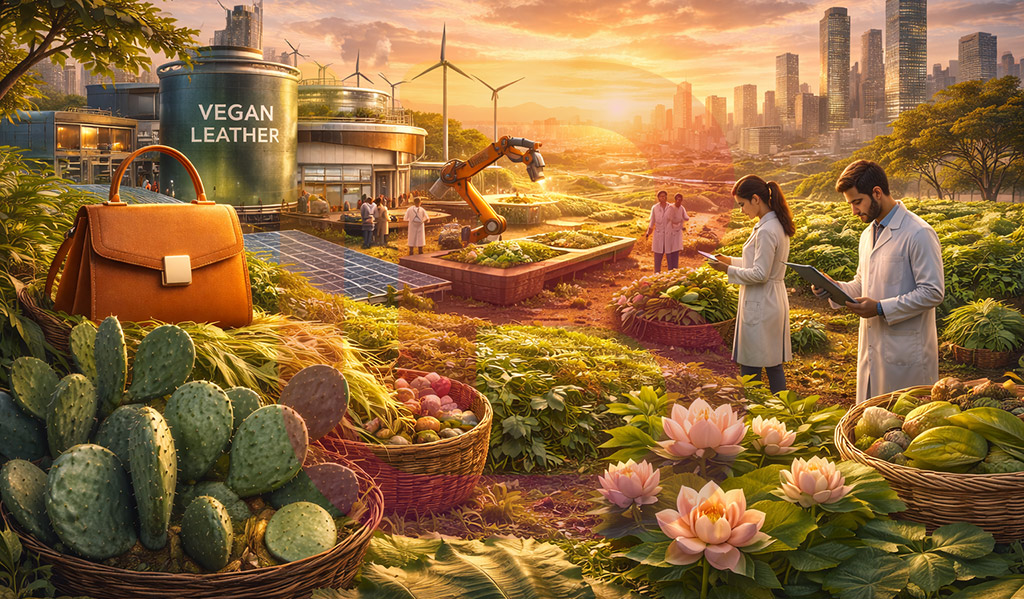
Made from plant-based, bio-fabricated, and recycled polymers, modern vegan leather is now produced using materials such as:
- Pineapple fiber (Piñatex)
- Mushroom mycelium
- Apple peels
- Cactus fiber
- Corn-based biopolymers
- Recycled PET and PU composites
This shift is not driven by ideology.
It is driven by climate economics, ESG compliance, and global regulatory pressure.
The world is moving from “Should we be sustainable?”
To “You will not survive if you are not.”
Global Brands Have Already Made the Decision
The market signal is already unambiguous.
World-leading luxury and fashion brands including Stella McCartney, Zara, Hugo Boss, Gucci, Adidas, Nike, H&M, Tesla, BMW, and Mercedes-Benz have already integrated plant-based leather, synthetic leather, and recycled polymer leather into their core product lines.
This is not a pilot.
This is strategic repositioning.
Why?
Because consumers — especially Gen Z and millennials — are now:
- Climate-conscious
- Cruelty-aware
- Brand-ethics driven
- ESG-aligned
The future of luxury fashion materials is no longer about aesthetics alone.
It is about carbon footprint, ESG compliance, traceability, and circular economy integration.
The India Opportunity: A Market Hiding in Plain Sight
India is uniquely positioned to dominate this category.
According to industry projections, India’s synthetic and vegan leather market was valued at approximately ₹31,396 crore (US$3.6 billion) in 2024 and is expected to reach ₹45,349 crore (US$5.2 billion) by 2033.
But the real opportunity is far larger.
India already has:
- One of the world’s largest leather manufacturing ecosystems
- Deep MSME clusters (Kanpur, Chennai, Ambur, Agra, Kolkata)
- A strong footwear and accessories export base
- Cost-efficient manufacturing infrastructure
- A massive domestic consumption market
Vegan leather allows India to upgrade this legacy sector into a future-proof, export-driven, ESG-compliant industrial engine.
This is not disruption.
This is strategic industrial transformation.
Government Backing: Policy Is Already in Motion
The Indian government has quietly but decisively begun aligning with this shift.
Initiatives such as:
- Sustainable Leather Initiative (SLI)
- Dedicated funding programs (~₹200 crore) for eco-friendly material research
- MSME technology upgradation schemes
- Production Linked Incentive (PLI) frameworks
- Make in India & Startup India missions
are already building the policy foundation for bio-material and green manufacturing sectors.
The government sees what most startups have not yet fully realized:
Vegan leather is not a fashion story.
It is a strategic manufacturing, export, and employment story.
Why Vegan Leather Is a Perfect Startup Category
For Indian startups, vegan leather offers a rare combination of:
1. Massive Market Demand
Across fashion, automotive interiors, furniture, footwear, luxury accessories, consumer electronics, and travel goods.
2. ESG and Climate Alignment
Directly aligned with:
- Sustainable materials
- Circular economy
- Low-carbon manufacturing
- Climate-tech investments
3. High IP Potential
Deep scope for:
- Material science innovation
- Bio-fabrication patents
- Proprietary formulations
- Process engineering
4. Export Scalability
Global demand from Europe, US, Japan, Middle East.
5. Policy and Capital Tailwinds
Access to:
- Government grants
- ESG funds
- Impact investors
- Green finance instruments
In venture terms, this is a Category-Creating Opportunity.
Low saturation.
High global demand.
Strong regulatory support.
Structural inevitability.
Environmental Impact: Why This Category Is Non-Negotiable
Traditional leather:
- Consumes ~17,000 liters of water per kg
- Emits massive methane via livestock
- Pollutes rivers with toxic tanning chemicals
- Generates hazardous solid waste
Vegan leather:
- Uses 80–90% less water
- Has significantly lower carbon footprint
- Eliminates animal cruelty
- Enables recyclable and biodegradable materials
- Supports circular economy models
This is not greenwashing.
This is system-level environmental redesign.
The Strategic White Space No One Is Talking About
India is currently exporting:
- Footwear
- Bags
- Garments
- Auto interiors
But importing:
- Advanced materials
- Bio-polymers
- Sustainable composites
The next real leap is not in finished products.
It is in owning the material layer itself.
Whoever controls bio-material IP controls:
- Global supply chains
- Pricing power
- Brand ecosystems
- Export dominance
This is where India can move from manufacturing hub to materials superpower.
The Role of iBluu Corporations: Engineering The Ecosystem
This is where iBluu Corporations operates — not as advisors, but as strategic ecosystem architects.
Through:
- iBluu Ventures Private Limited
- iBluu InfraVenture Private Limited
- iBluu Consulting Venture Private Limited
iBluu works across the full value chain:
- Business and Strategic Consulting
- Strategic Government Engagement and Policy Advisory
- Investment Advisory and Capital Structuring
- Mergers & Acquisitions
- Public-Private Partnerships
- Industrial Alliances and Global Market Entry
iBluu does not just support startups.
It builds institutional frameworks where emerging sectors scale into national industries.
Vegan leather is not a startup idea.
It is a national strategic category in waiting.
Final Strategic Reality
The next wave of global value creation will not be built on apps.
They will come from:
- Sustainable materials
- Climate technology
- Bio-manufacturing
- ESG-aligned industrial platforms
And vegan leather sits at the exact intersection of all four.
This is not a trend.
This is not a niche.
This is not optional.
This is India’s next industrial advantage.
Those who enter now will not compete.
They will define the category.
Those who delay will not miss a market.
They will miss the decade.
Vegan leather sits at the intersection of:
Vegan leather industry in India
Sustainable fashion materials
Bio-based leather alternatives
Climate tech startups India
Sustainable manufacturing India
ESG investment opportunities
Green materials innovation
Circular economy India
Eco-friendly leather alternatives
Plant-based leather market
Future of fashion materials
Impact investing India
Sustainable supply chains
Make in India green manufacturing
For Indian startups, vegan leather is not an option.
It is one of the few remaining white-space sectors with global scale potential.