+91 945 889 6091
  infodesk@ibluu.com
Mother of All Deals: Europe’s Strategic Trade Pact With India And The Rewriting of Global Economic Power And Future In India
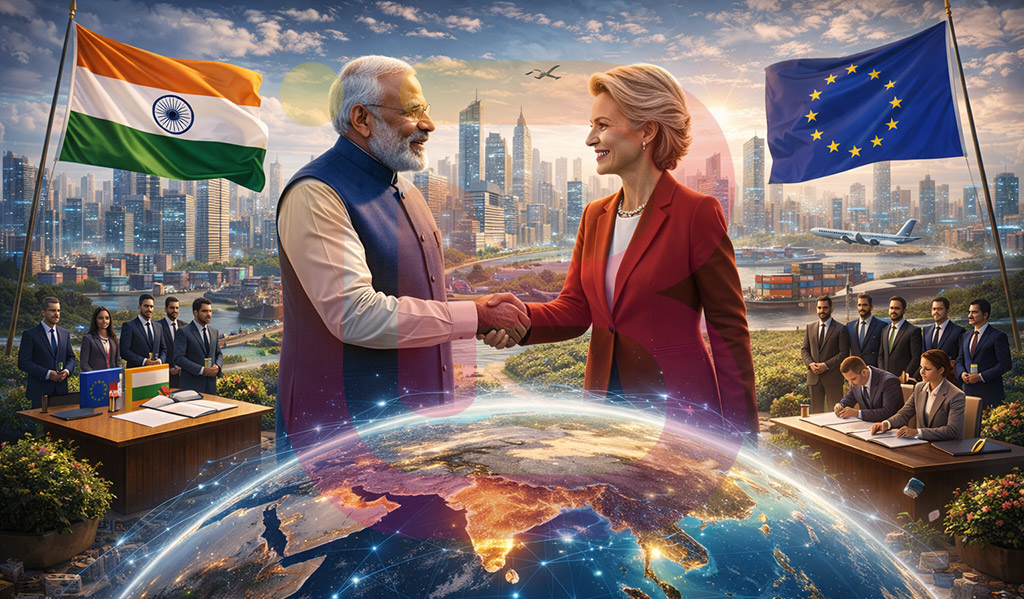
In global trade history, some agreements are transactional. Others are transformational. The emerging Europe–India Trade Deal belongs firmly to the second category. It is not merely a commercial arrangement between two large economies — it is a structural realignment of global economic gravity. That is why policymakers, investors, and institutions are already calling it the “Mother Of All Deals.”
This deal is not about tariffs alone. It is about power, positioning, supply chain sovereignty, geopolitical hedging, and the long-term architecture of global growth. Europe is not just trading with India; it is strategically anchoring its future in India.
And India is not just signing a trade pact; it is stepping into the role of a systemically important economic power.
Why This Is Called The “Mother Of All Deals”
Because no other trade agreement currently in negotiation carries this level of economic mass, strategic depth, and geopolitical consequence.
Consider the scale:
- The European Union: ~450 million consumers, $18+ trillion economy.
- India: 1.4 billion population, fastest-growing major economy, soon to be the world’s third-largest GDP.
This is not a bilateral trade deal.
This is a global economic axis.
It connects:
- Europe’s capital, technology, standards, and advanced manufacturing
with - India’s scale, talent, domestic consumption, digital infrastructure, and growth velocity.
In strategic terms, this deal:
- Redefines supply chains.
- Rebalances global manufacturing.
- Creates a new trade corridor outside China-centric dependence.
- Positions India as Europe’s most critical long-term economic partner in Asia.
That is why it is the Mother Of All Deals.
Not because it is big — but because it is system-defining.
Why This Deal Is Mission-Critical For India
For India, this deal is not about exports alone.
It is about graduating from an emerging economy to a rule-shaping economy.
This agreement accelerates four national objectives:
1. India’s Manufacturing Superpower Ambition
The deal strengthens India’s role as:
- Europe’s manufacturing base.
- A global alternative to China.
- A key node in global value chains.
It directly supports:
- Make in India
- Production Linked Incentive (PLI) schemes
- Industrial corridor development
- High-end manufacturing in electronics, semiconductors, EVs, defence, aerospace, and green energy.
2. Capital Inflows And Investment Sovereignty
Europe brings:
- Patient capital.
- Long-term institutional investors.
- Strategic infrastructure funding.
- Green finance.
This shifts India from speculative FDI to strategic FDI.
Not hot money — but nation-building capital.
3. Technology Transfer And Standards Power
Europe does not export only products.
It exports:
- Compliance frameworks.
- ESG standards.
- Cybersecurity architecture.
- Sustainability protocols.
- Advanced industrial governance.
This raises India’s global credibility from a low-cost producer to a high-trust economic partner.
4. Geopolitical Repositioning
This deal positions India as:
- Europe’s primary strategic partner in the Indo-Pacific.
- A balancing force in the US–China binary.
- A non-aligned yet system-critical global power.
India is no longer on the sidelines of global order.
India is now co-authoring it.
Key Highlights Of The Europe–India Trade Deal
While negotiations are still evolving, the strategic contours are clear:
Core Economic Pillars
- Reduction of tariffs across industrial and consumer goods.
- Market access for services, IT, fintech, and digital trade.
- Investment protection frameworks.
- Intellectual property cooperation.
- Green technology and climate finance.
- Mobility of skilled professionals.
- Supply chain integration.
Strategic Sectors Impacted
- Manufacturing and industrial goods
- EV and renewable energy
- Semiconductors and electronics
- Pharmaceuticals and biotech
- Defence and aerospace
- Digital infrastructure and AI
- Financial services and fintech
This is not sectoral growth.
This is systemic economic rewiring.
Pros And Cons: A Strategic View
The Strategic Upside
For India
- Massive export growth.
- Global brand credibility.
- Advanced technology access.
- High-quality job creation.
- Institutional capital inflow.
- Stronger currency and fiscal resilience.
For Europe
- Supply chain diversification.
- Cost-efficient production base.
- Access to India’s consumer market.
- Strategic hedge against China risk.
- Long-term growth partnership.
The Strategic Risks
No great deal is without friction.
For India
- Regulatory pressure to align with EU standards.
- Increased competition for domestic MSMEs.
- Compliance burden for small exporters.
- Data protection and digital sovereignty challenges.
For Europe
- Political complexity of Indian market.
- Policy unpredictability.
- Cultural and operational friction.
- Long gestation on returns.
But these are not deal-breakers.
They are the price of strategic relevance.
Impact On The Indian Economy
The macroeconomic impact is profound:
- Higher GDP growth trajectory.
- Stronger manufacturing base.
- Deeper integration into global trade.
- Increased FDI and capital markets depth.
- Rise of India as a global export hub.
- Stronger currency fundamentals.
- Structural job creation.
More importantly, it shifts India from:
“Low-cost growth story”
to
“Systemically important economic power.”
This is how nations move from potential to power.
How The World Sees This Deal
Global institutions see this deal as:
- A validation of India’s long-term stability.
- A bet on India’s demographic dividend.
- A recognition of India’s political continuity.
- A hedge against global supply chain fragility.
- A signal that India is now unavoidable in global economics.
In investor language:
India is no longer optional.
India is systemically unavoidable.
India’s Superpower Ambition: This Is The Bridge
India’s superpower ambition was never about slogans.
It was always about:
- Capital.
- Technology.
- Manufacturing.
- Governance.
- Trade architecture.
This deal provides the missing bridge between:
- Domestic ambition
and - Global legitimacy.
It moves India from aspiring superpower to institutional superpower.
The Strategic Role Of iBluu Corporations
This is precisely where iBluu Ventures, iBluu InfraVenture, and iBluu Consulting Venture operate at the highest strategic altitude.
As a consulting and strategic advisory group, iBluu’s role sits at the intersection of:
- Business And Strategic Consulting
- Strategic Government Engagement
- Infrastructure Advisory
- Investment Advisory
- Mergers And Acquisitions
- Cross-border Partnerships
- Technology And Digital Consulting
In deals of this magnitude, success is not determined by policy alone.
It is determined by execution architecture.
iBluu positions itself as:
- The strategic bridge between European capital and Indian opportunity.
- The advisory layer between policy frameworks and private enterprise.
- The execution partner between ambition and reality.
Where governments design frameworks,
iBluu engineers outcomes.
Where investors see complexity,
iBluu builds clarity.
Where corporations see opportunity,
iBluu builds strategy, structure, and scale.
Final Thought: This Deal Is Bigger Than Trade
This is not about exports and imports.
This is about who controls the future of global growth.
Europe is choosing India.
Not as a market.
Not as a partner.
But as a strategic pillar of global economic order.
And India, for the first time in modern history, is not being invited into the system.
India is being asked to co-design it.
That is why this is not just a deal.
This is the economic turning point of the decade.
The Mother Of All Deals.