+91 945 889 6091
  infodesk@ibluu.com
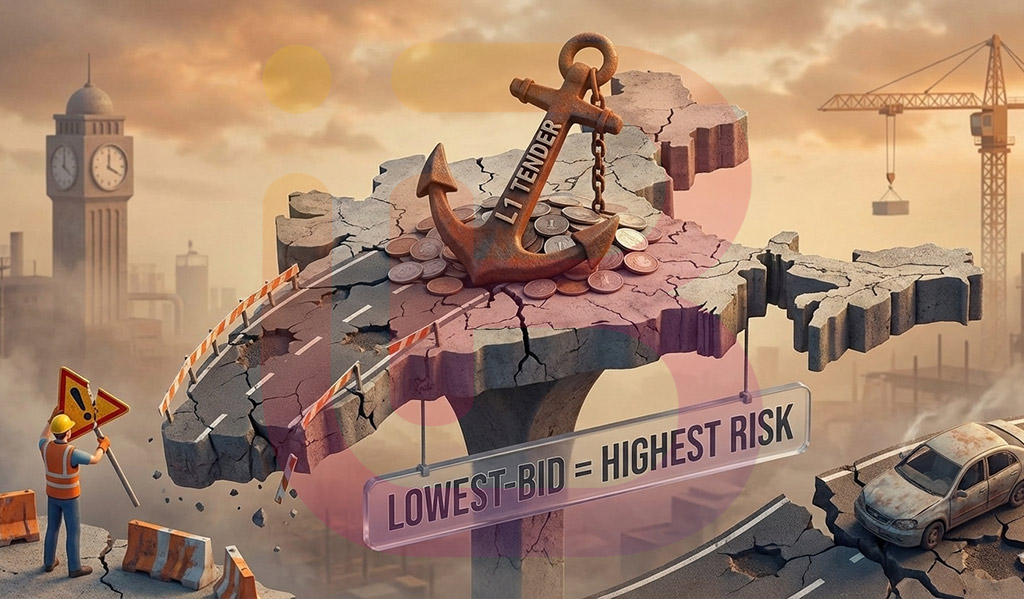
India’s Infrastructure Crisis Begins at the Tender Table: When Lowest-Price Bidding Is Breaking India’s Infrastructure System
India is building at unprecedented speed. Highways, expressways, and arterial roads are expanding the nation’s economic surface area and reshaping logistics, mobility, and regional growth. Yet beneath this momentum lies a structural flaw that threatens durability, safety, and public trust:
The systemic over-reliance on ultra-low bidding as the primary determinant of contract awards.
This is not a capacity issue.
India is not short of ambition.
It is not short of funding.
And it is certainly not short of contractors.
It is a policy issue.
What India is increasingly short of, however, is institutional courage to confront a dangerous truth:
Our infrastructure problem is not execution. It is incentives.
And nowhere is this more visible than in road construction.
The Problem Is Not Competition — It Is Distorted Competition
Healthy competition improves efficiency.
Distorted competition destroys value.
In today’s road construction ecosystem, it is increasingly common to see bidders quoting 35%–45% below estimated project cost—levels that are economically unsustainable for quality execution.
The math is unforgiving.
When a contractor wins a tender at such steep discounts, three realities collide:
- Margins are already negative on paper
- Additional professional, compliance, and facilitation costs are incurred at allotment
- Inflationary material pressures
- Timelines and quality benchmarks remain unchanged
The outcome is predictable.
To survive, not to excel, contractors are pushed toward:
- Sub-standard raw materials
- Compromised engineering practices
- Reduced thickness, durability, and lifecycle performance
- Deferred maintenance risks transferred to the public exchequer
This is not poor execution.
This is forced degradation.
Lowest Bid ≠ Lowest Cost to the Nation
The irony is stark.
A road built cheaply but rebuilt repeatedly costs far more—financially, socially, and reputationally—than a road built right the first time.
Lifecycle economics tell a clear story:
- Poor-quality roads demand early rehabilitation
- Maintenance budgets balloon silently
- Accident risk increases
- Public confidence erodes
- Long-term asset value collapses
In effect, the nation pays multiple times for the illusion of savings once.
Why Disqualifying Low Bidders Alone Is Not the Answer
Simply banning low bids is neither practical nor fair.
Many efficient, disciplined companies can deliver genuine cost advantages through:
- Superior procurement
- Process optimization
- Technology adoption
- Strong balance sheets
The issue is not low cost.
The issue is unsustainable cost.
What India needs is intelligent filtering, not blunt exclusion.
What Must Change: From Price-Centric to Value-Centric Contracting
To protect quality without stifling competition, India’s road construction policy must evolve along five critical dimensions:
1. Introduce Bid Viability Thresholds
Bids beyond a defined deviation from estimated cost should trigger:
- Mandatory financial justification
- Detailed execution methodology review
- Independent cost realism assessment
2. Weight Quality, Not Just Price
Tender evaluation must assign material weight to:
- Past performance and defect history
- Asset durability track record
- Safety compliance
- Technology and materials used
Price should remain a factor—but never the only one.
3. Enforce Lifecycle Accountability
Contractors must be accountable not just for construction, but for:
- Performance over time
- Maintenance outcomes
- Measurable service-life benchmarks
This aligns incentives with national interest.
4. Penalize Repeat Quality Failures
Companies that consistently deliver sub-standard outcomes should face:
- Escalating penalties
- Reduced eligibility
- Reputation-linked scoring penalties
Brand value must matter.
5. Encourage Serious, Long-Term Players
India must reward companies that think in decades, not quarters—those who view infrastructure as:
- A legacy
- A brand
- A national responsibility
The Real Divide: Builders vs. Extractors
At the heart of the issue lies a cultural divide.
One group of companies seeks:
- Volume without vision
- Cash without credibility
- Contracts without consequences
Another builds:
- Reputation before revenue
- Quality before quantity
- Long-term brand equity
Policy must decisively favor the latter.
Because infrastructure is not a commodity.
It is a public promise.
A Strategic Imperative, Not a Technical Adjustment
If corrective policy is delayed, the consequences will compound:
- Rising maintenance burdens
- Accelerating asset degradation
- Increased public safety risks
- Erosion of trust in public procurement
India is entering a phase where speed must be matched with sophistication.
The next decade of infrastructure success will not be defined by kilometers built—but by kilometers that endure.
Conclusion: Build Less Cheaply. Build More Wisely.
India does not need fewer roads.
It needs better roads.
And better roads require:
- Smarter policy
- Courageous reform
- A shift from lowest cost to highest value
The choice is clear.
Either we continue to reward bids that look good on paper and fail on the ground—
or we redesign the system to reward those who build infrastructure worthy of a global economy.
The future of India’s roads depends on that choice.